SupaTalker Store edition: a store of your own, grown inside messaging apps
Marketplaces take a big cut and AI is changing how people shop. The Store edition puts your store inside messaging apps, with AI customer service at its core.
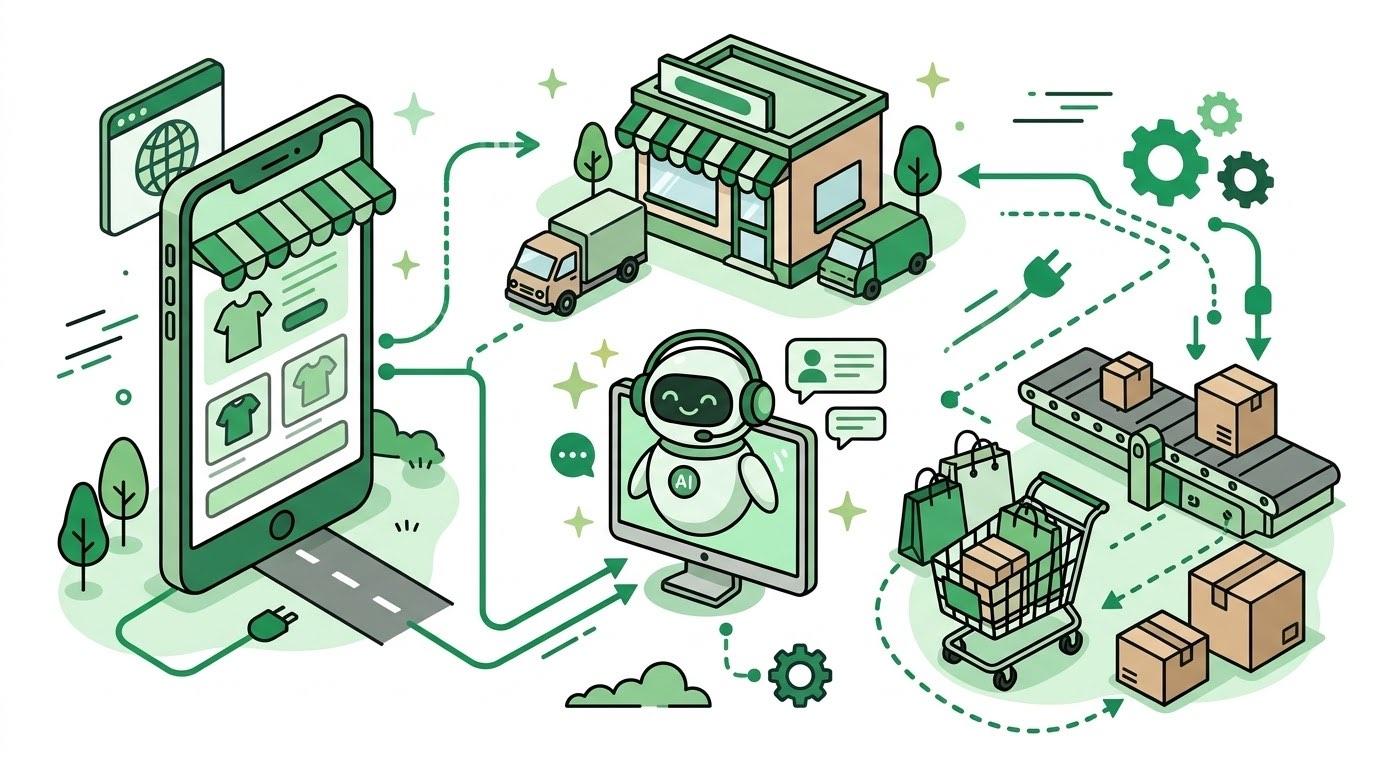
The SupaTalker Store edition is the first industry edition we have officially released. It is an online store that lives inside messaging apps such as LINE, built on the SupaTalker AI customer service core. Before we introduce it, we would like to start with what merchants are facing today.
1. The convenience of marketplaces, and its price
For merchants of every size, online marketplaces are today's mainstream and the easiest way to open a shop. Payments, shipping, convenience-store pickup and big seasonal sales events are all ready to go, and in recent years marketplaces have added live-stream shopping and video content to get even closer to shoppers.
But there is no such thing as a free lunch. Marketplaces draw merchants in with a very low barrier to entry, and the business model behind it is plain to see: commission on every sale, advertising fees, and the cost of promotional discounts passed on to merchants. Anyone who has run a shop on a marketplace knows this well.
Merchants end up giving away a sizable share of their margin: joining one sales event after another, and pouring money into an advertising budget with no bottom. Revenue may look high, but that does not mean profit is high too. If the products already run on thin margins, the business can end up making no money at all.
Overcompetition is also distorting the market. Cheap, low-quality goods, end-of-season stock sold under an "outlet" label, and counterfeits are everywhere, and the only thing left to compete on is price. Shoppers drawn in by low prices were never loyal to begin with; they go wherever the discount is biggest and the price is lowest.
What shoppers think is actually very simple:
If the product is the same, why should I buy it from your more expensive store?
On a marketplace, this question is hard to answer. The marketplace has already removed the friction and the trust issues between buyer and seller, handled payments and shipping, and set a baseline level of service. If you are an agent, distributor or retailer of products sold everywhere, on a marketplace you are just one more store with a different name. The only sales tactics left are price cuts, promotions and more ad spend, which is exactly what the marketplace wants.
The qualities that once set a merchant apart, such as good service, a friendly welcome, the reputation of a long-standing shop, honesty and a full product range, are soft, personal values that rarely get a chance to be seen on a marketplace. Ratings, descriptions and sales records on a marketplace are just data in the end, and they can even be built up and dressed up quickly in all sorts of ways.
2. At a crossroads: what do merchants have left?
When what made you different has been worn away and price is the only language left, it may be time to turn around and ask yourself:
Are the customers you have on the marketplace really loyal customers you can build a long-term relationship with?
Maybe, maybe not. Marketplaces do not necessarily want customers and merchants to get too close. To the marketplace, customers are a key business asset that the marketplace created, not the merchant.
So what do merchants still have? The regulars who know you at your physical store, the followers who like and comment on your social media (Facebook, Instagram, LINE), and the long-time customers who come back to buy again and again. These relationships are the assets that truly belong to the merchant.
Standing at this crossroads, merchants have a few roads to choose from:
- Keep fighting the high-revenue, low-margin price war on the marketplace?
- Keep raising the marketplace ad budget for a moment of exposure?
- Or go back to running an online store of your own?
The third road is not new. Ten years ago, a merchant's own shopping website was the ideal channel. But beyond the cost of building and running it, a website also needed investment in online ads and SEO, or it would bring in no visitors at all.
Then smartphones became everyday devices and gradually replaced traditional website browsing, and many merchants started building their own apps. The barrier is very high: development and maintenance cost several times more than a website, and the harder part is getting customers to download and install the app on their own. So most merchants settled for second best and simply rebuilt their websites as responsive (RWD) sites.
The road to running your own store has always been there; it is just that every route comes at a cost. And while merchants are still weighing their options, the view from the crossroads is already changing fast.
3. The AI era: where is online shopping headed?
The AI era has arrived, and every merchant now faces new challenges.
Online business used to depend on search engines and SEO. Now shoppers are learning that they do not have to use a search engine, and they may never see an online ad. The age of "asking AI" to choose products and get recommendations is already here. Website traffic that merchants spent years building is being redistributed.
At the same time, mobile devices and messaging platforms are everywhere. Which apps do shoppers spend the most time on each day? Where does their attention go?
- Watching videos: YouTube, TikTok, Facebook
- Messaging: LINE, Facebook, Instagram, Threads, Discord
- Shopping: Coupang, Shopee, momo, PChome, Taobao
- And of course, games, which take up a huge amount of time
Among all this, the time spent actually opening a web browser is small. And most of these apps, messaging apps in particular, have a built-in browser, because messaging app providers never wanted users to leave their app in the first place.
Facing this shift, how should merchants invest in and build their own customer-facing AI customer service, or internal AI tools? How much does it cost to adopt a new technology? How much time does it take to keep up with technology that moves this fast? What if it changes too quickly to follow? How many merchants can build an AI customer service system that is truly fit for business use? It takes capital and people who understand the technology, and most small merchants have neither the budget nor the staff.
What is more, AI is only just beginning to take root in business, and it still has a long way to go before it reaches everyday shoppers. You can build a product or service with the latest technology, but the broad consumer market may not need it that much or that urgently yet. This is still a very early market. Over the next few years, as AI becomes widely used and shoppers accept it and change their habits, until those habits become the norm, the market will reach maturity.
"The horse carriage and the car" is the classic analogy for AI applications, digital transformation and technological revolutions. If you had asked a coachman in the 19th century what he needed, the answer would surely have been "a faster, stronger horse", because his imagination was limited by the tools he already had. He could never have imagined an invention like the car, which needs no horse at all.
Online shopping stands at the same turning point. The next generation of online stores should not just be an old website with an AI chat box added on; that is only a faster horse. Real AI applications should break the old mold and imagine business models and services that never existed before.
4. The SupaTalker Store edition: a store of your own, built for the future
The SupaTalker Store edition is our answer to these questions: give merchants their customers back, open the store inside the messaging apps where customers' attention already is, and build it around AI from the ground up.
The SupaTalker Store edition sets out to do two things: bring AI customer service within reach, and connect an online store seamlessly to mobile messaging platforms.
A new channel that belongs to the merchant
The SupaTalker Store edition is not meant to replace existing marketplaces or a merchant's own website. It is a new channel.
A merchant's existing channels usually fall into these groups:
- Physical channels: permanent stores, short-term or pop-up shops (stalls, temporary exhibitions and so on)
- Marketplaces: Shopee, LINE Shopping, Rakuten and so on
- Online stores: self-built websites or other store-building platforms
- Brand marketing channels: social media platforms, video platforms and so on
The Store edition is neither a large system like a marketplace nor a typical website, so it cannot replace any of the above and does not try to. It is one more channel to add, made for your regulars and loyal customers: the people you see often, who know you, or who have already bought from you many times.
You can also think of it as a store-building platform: it has all the basics, including ordering, payments, shipping and support tickets. The difference is that it connects directly to member identities on social messaging platforms and has AI customer service built in.
A store grown inside messaging apps
The Store edition is a website in its own right. You could call it a small shopping site, a web page or a web app, but it has been redesigned for mobile devices and messaging platforms:
- It is an online store grown inside messaging platforms. Like any online store, it belongs to the merchant, but it aims for a closed, focused experience on mobile devices: it does not rely on SEO, and it is not the kind of store people browse on a desktop. Think of it as an online store run on mobile devices. From the interface to the whole shopping flow, we do our best to make it smooth.
- Member identity is tied directly to the messaging platform. For example, a visitor who comes from LINE is identified by their LINE account, and the same goes for other platforms. That is why it deliberately has no sign-up or login: customers' identities carry straight through, so they can start using it the moment they open it.
- It is built for phones. Its viewing size, controls and interface are close to a mobile app, rather than a responsive (RWD) web page that scales to fit any screen. It can also be used in a regular browser (this requires a member identity, connected through a host website), but that option can be turned off. At heart, it is a browsing experience rebuilt for phones and messaging platforms.
It can be connected to LINE, Facebook Messenger, Instagram and the Web. Facebook Messenger is connected through a Facebook Page. In Taiwan and Japan, LINE is the most widely used messaging platform.
As a result, its customer journey is completely different from that of a typical store-building platform:
- Typical store-building platform: search engine / video / social media → website
- SupaTalker Store edition: video / social media / website → messaging app → store
Take LINE as an example. Once the merchant connects a LINE Official Account, customers do not need to sign up or log in. They just tap "Online Store" in the menu, or type a keyword the merchant has set up in the admin (for example, "store" or "shop"). The AI customer service bot replies with a button carrying a secure link, and one tap takes them straight into the store to browse, place an order or open a support ticket. Support tickets are the channel for after-sales service and for contacting the merchant, handled mainly through email and the message history in the admin area.
When customers have a question, or want to ask about a particular product, they can ask directly in LINE or on the message page built into the store. Conversations from both places are recorded in one place. The difference is that the full conversation history is not visible in LINE, while the store shows the LINE conversation history as well. These are simply two ways to make questions and answers feel smoother and more natural. Customers can use whichever they prefer, and the quality of service is exactly the same.
AI customer service at its core
Underneath, the Store edition runs on the SupaTalker AI customer service core. Product content, specifications, prices, Q&A, and even orders and support tickets automatically become information the AI can answer from. In return, compared with a typical shopping website, this information goes through stricter checks and requirements before it enters the RAG (retrieval-augmented generation) index, which takes a little more effort. Existing data can also be integrated and imported, but this needs to be customized case by case.
This is the first thing the Store edition sets out to do: give everyday merchants customer-facing AI customer service that is truly fit for business. We use leading commercial AI models and top-tier cloud hosting, and we have put real care into system security and personal data privacy. At the same time, the entry price is affordable enough for almost any merchant. We aim not only to challenge the lowest prices among similar services, but also to lead with innovative technology.
Why a store?
You might wonder: if SupaTalker's AI customer service already works, why build a separate online store for messaging platforms?
Because what we want to build is not "a faster horse". The Store edition is not AI features added to an existing shopping website; its core and foundation are SupaTalker's AI agent design. In this store, we have sketched out the many faces of the online store of the future. We do not make a point of where AI is used in the admin or the storefront, or of putting AI everywhere. The store itself is built in the shape of that future.
In closing
The SupaTalker Store edition is our AI agent core put into real-world use. But more than a system, we hope it is a path we walk together with merchants: beyond the marketplaces, a place to take good care of your regulars; inside the messaging apps your customers visit every day, a store that is always open; and AI customer service as the helpful assistant who never closes up shop.
The AI era is changing fast, and no one can see every direction alone. We hope SupaTalker can be a business partner that grows together with every merchant, facing the trends and challenges of the new AI era side by side.
We will also be releasing more industry editions in the future. They all come from the same core technology, and they all share the same original intention.